
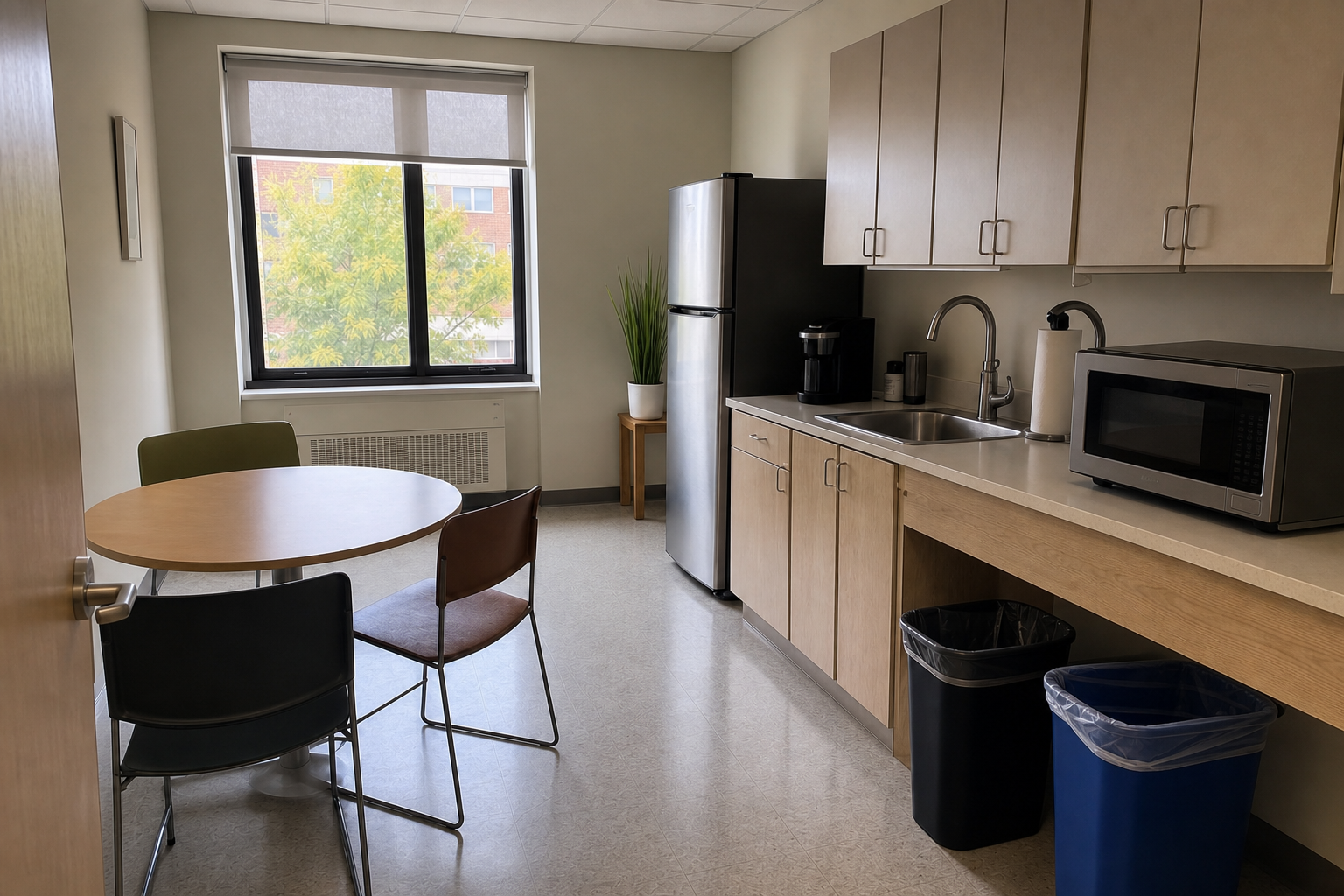
An office break room is small compared with the rest of a workplace, but it can generate a surprising amount of daily cleaning work. Coffee drips, food crumbs, fingerprints, full trash bins, refrigerator spills, and tracked-in debris all collect in one shared space. Without a clear plan, employees may assume the cleaner handles every item while the cleaner may be instructed not to move food, personal containers, or unmarked supplies.
Ready to plan your cleaning?
Review office & commercial cleaning services and confirm your rooms, priorities and timing.
A better approach separates routine commercial cleaning from employee responsibilities and scheduled appliance-detail tasks. For a Bayside office, that written scope can make service more consistent, reduce confusion, and help the break room remain usable throughout the workweek.
Give the break room its own cleaning scope
Do not treat the break room as an ordinary office. List the surfaces, appliances, fixtures, floors, bins, and supply areas that are included during each visit. Identify anything outside the scope, such as employee dishes, food containers, refrigerator contents, coffee-machine maintenance, or specialty equipment.
The plan should state who clears tables and counters before cleaning begins. If personal items cover the surfaces, the cleaner may not be able to reach them safely or return them to the correct owner. A simple rule—such as placing all labeled belongings in one designated area—can preserve access without risking misplaced items.
Choose frequency based on actual use
A six-person professional office and a busy customer-facing workplace may need different schedules even if their break rooms are the same size. Consider the number of employees, operating hours, meal patterns, visitors, cooking appliances, waste volume, floor type, and whether the space is used on weekends.
- Every service visit: clean accessible counters, tables, sink surfaces, appliance exteriors, touchpoints, bins, and floors included in the scope.
- On a planned rotation: detail cabinet fronts, chair bases, wall splash areas, corners, baseboards, and the outside or surrounding area of larger appliances.
- By separate request: clean appliance interiors, empty and detail the refrigerator, wash bins, or address buildup that requires extra time.
Use a schedule that reflects when the room is busiest. A visit immediately before the main lunch period may leave the area messy for the rest of the day, while a later service may better support the next morning. Access, staffing, and building rules will determine the best window.
Clear dry debris before wiping counters
Begin with loose crumbs and visible debris so they are not pushed onto the floor or into appliance seams. Remove movable items only when authorized, then return shared supplies to their designated locations. Use tools that will not scratch the countertop material.
Countertops can include laminate, solid surface, stone, stainless steel, or other finishes. Follow the approved care method for the specific material, especially around natural stone or specialty coatings. Do not use the same chemical on every surface simply because the room is small.
Create a policy for shared appliances
Appliance exteriors are commonly included in routine cleaning, but interiors require more planning. A microwave may contain food, a refrigerator may hold labeled meals, and a toaster or coffee machine may have manufacturer-specific cleaning instructions. Define what the cleaner can open, move, discard, unplug, or leave untouched.
Microwaves and small cooking appliances
Employees should cover food when heating it and wipe major spills promptly. During scheduled cleaning, the interior can be addressed only when it is included, cool, accessible, and safe to handle. Do not scrape a coated surface with an abrasive tool or apply a product that is not approved for food-adjacent use.
Refrigerators and freezers
Post a written cleanout schedule and give employees advance notice. Decide who removes expired, unlabeled, or abandoned food; a cleaning company should not guess which items are personal property or still wanted. For a detailed interior cleaning, arrange for contents to be removed or transferred according to the office plan.
Door handles, exterior panels, and the accessible floor around the refrigerator can be part of routine service. Moving a heavy appliance or cleaning coils, water lines, or mechanical components is a separate maintenance issue and should be assigned appropriately.
Pay attention to the coffee station
Coffee grounds, sugar, creamers, stirrers, and water drops can create a sticky work area. Keep cups and supplies in labeled zones so the counter remains accessible. Empty drip trays and clean coffee equipment only according to the manufacturer’s directions and the assigned office responsibility.
Routine cleaning can address the accessible counter, cabinet fronts, backsplash, and appliance exterior. Descaling, filter changes, internal brewing components, and repairs should not be assumed to be part of general commercial cleaning.
Keep the sink area functional
Remove food scraps from accessible sink surfaces and wipe faucets and surrounding counters with an appropriate method. Employee dishes should be handled according to the office policy. If cleaners are not assigned to wash personal items, a full sink can prevent them from cleaning the basin.
Report slow drainage, leaks, loose fixtures, unusual odors, or damaged seals to the designated contact rather than attempting a repair. Do not combine drain products or mix cleaning chemicals. Plumbing and mechanical issues require the appropriate service provider.
Clean tables, chairs, and touchpoints
Tables should be cleared before wiping. Include chair backs, seats, arms, and accessible bases on a practical rotation, since crumbs and spills often collect below the tabletop. Use care around upholstered seating and confirm whether spot treatment is included.
Frequently handled areas may include refrigerator handles, cabinet pulls, microwave buttons, faucet controls, vending-machine buttons, and door hardware. Cleaning frequency should reflect office use and the agreed scope, not a generic list applied to every workplace.
Set clear trash and recycling rules
Identify which bins should be emptied, where replacement liners are stored, and where waste must be taken. Separate food waste, recycling, compost, and general trash according to the building and office procedures. Do not leave leaking bags in hallways or block exits while collecting waste.
If employees dispose of liquids, sharp objects, batteries, electronics, chemicals, or other restricted materials, provide appropriate office policies and containers. General cleaners should not be expected to sort unknown or hazardous items from an ordinary trash bag.
Finish with floors and a final reset
Clean floors after counters, tables, appliance exteriors, and bins so falling debris is collected once. Vacuum or sweep dry material before damp cleaning. Use the approved method for tile, vinyl, laminate, wood, carpet, or other flooring and plan an exit path around wet areas.
Before leaving, return authorized shared items to their labeled locations, replace liners, and check that no cleaning cloths or supplies remain on food-preparation surfaces. Confirm that appliances were left in their required state and that the room is accessible for the next work period.
Provide complete details for a commercial quote
When requesting commercial cleaning in Bayside, NY, share the office size, employee count, operating hours, service frequency, break-room appliances, floor types, waste procedures, access rules, supply responsibilities, and any appliance interiors or detail tasks you want included.
Crystal Breeze Cleaning provides commercial office cleaning based on the workplace, schedule, access, and requested priorities. Call 516-789-2767 to discuss a customized cleaning plan for your Bayside office and shared break-room areas.
Ready to plan your cleaning?
Review office & commercial cleaning services and confirm your rooms, priorities and timing.